Face Yoga for Hooded Eyes: 2 Exercises to Try With Me
Oct 06, 2026If your eyes have started looking more hooded, you may notice that less of your eyelid is visible or that your eyes look tired even when you feel rested. Maybe applying eye makeup feels different, or one side seems heavier than the other.
It’s understandable to notice these changes. You can accept the way you’re aging and still want to care for your face and feel good when you look in the mirror.
In this tutorial, I guide you through two facial exercises that focus on the muscles around your eyes and upper cheeks. We’ll practice together, with time to breathe and reset between sets.
Can face yoga help hooded eyes?
Face yoga works with facial movement and muscle awareness, but it has not been established as a treatment that removes excess eyelid skin or corrects a drooping eyelid. My aim with this routine is to help you explore controlled movement around your eyes and cheeks, while noticing how the area feels.
Research on facial exercises is still limited. A small 2018 pilot study reported improvements in cheek fullness after a 20-week facial exercise program. It did not establish that these two exercises lift hooded eyelids.
That leaves room for a practice you enjoy, with realistic expectations. You don’t need to promise yourself a dramatic change to make a few minutes of face care worthwhile.
Why do eyes become more hooded?
“Hooded eyes” usually describes a fold of skin that covers part of the upper eyelid. Some people naturally have this shape. For others, it becomes more noticeable with age.
Several different things can influence the appearance of the eye area.
Your natural eye shape and changes in the skin
Genetics can influence how much upper eyelid skin you have. With age, skin and supporting tissues can become less elastic, making the fold more noticeable. The medical term for excess, loose eyelid skin is dermatochalasis.
The position of your eyebrows
A lower eyebrow can also make the upper eye area look more hooded. This is why looking only at the eyelid doesn’t always give you the full picture. An eye assessment may consider both the eyelid skin and the brow position.
Puffiness versus hooding
Swelling and excess skin are different concerns, even when both make the area look fuller. If the appearance varies throughout the day, notice that pattern rather than assuming every change comes from loose skin. Persistent swelling deserves an assessment.
A drooping eyelid
A drooping eyelid, called ptosis, means the upper eyelid edge sits lower than it should. This differs from a fold of skin covering the eyelid. It can involve the muscles or tissues responsible for raising the eyelid. Facial exercises are not a substitute for identifying its cause.
If a droop is new, develops suddenly, or affects your vision, seek medical assessment rather than trying to exercise it away.
Which muscles are involved?
There are different muscles doing different jobs around your eyes:
- Orbicularis oculi: the muscle around the eye that closes the eyelids.
- Frontalis: the forehead muscle that raises the eyebrows.
- Corrugator supercilii: a small muscle that draws the eyebrows inward and downward.
- Levator palpebrae superioris: a muscle that raises the upper eyelid.
This distinction matters. Closing your eyes against resistance works with the eye-closing action. It should not be described as directly strengthening the muscle that opens your upper eyelid.
My routine also includes lifting the cheeks. The goal is to practice specific movements while keeping the rest of your face and body as relaxed as possible.
Why I pay attention to more than the eyelids
When you concentrate on an exercise, it’s easy to clench your jaw, lift your shoulders, or hold your breath without realizing it.
That is why I keep reminding you to relax those areas in the video. I want you to feel the movement we’re practicing without adding unnecessary tension elsewhere.
Releasing tension is an important part of my wider approach to facial care. However, neck, jaw, or scalp tension should not be presented as the explanation for every hooded eyelid. Natural anatomy and changes in the skin and brow also matter.
This particular tutorial teaches two exercises. It does not include a separate massage or lymphatic drainage sequence.
Exercise 1: Eye closure with supported brows
First, I show you the hand placement, then we practice together.
- Sit with your back straight and your shoulders relaxed.
- Place your palms over the outer portion of your eyebrows, approximately from the second third toward the ends.
- Apply comfortable support and a slight upward lift. Keep the space between your eyebrows smooth.
- Close your eyes against the resistance of your hands for about five seconds.
- Open, reset, and repeat.
In the video, we do 10 repetitions.
Keep your jaw unclenched and continue breathing. Support the brow area without pressing on your eyeballs or pulling hard on the skin. You do not need to squeeze forcefully.
Exercise 2: The cat’s eye exercise
This exercise combines a lifted-cheek position with supported eye closure. The video is especially helpful here because you can see how I position my jaw and hands.
- Use your fingers to guide your chin downward as you open your jaw, keeping it aligned rather than pushing it forward.
- Bring your lips inward and lift your cheeks.
- Keep your back straight, with a slight upward head tilt that feels comfortable for your neck.
- Place your palms at the outer eye corners and give a small, comfortable upward lift.
- Close your eyes and hold while breathing naturally.
In the tutorial, we aim for three holds of about 30 seconds, resting between them.
If you can only hold for 10 seconds, that’s okay. Come out of the position if your shoulders rise, your jaw or neck becomes uncomfortable, or you start holding your breath. Reset before continuing.
Watch and practice with me
You don’t have to remember all the instructions or count the holds yourself. I demonstrate each exercise and guide you through the practice.
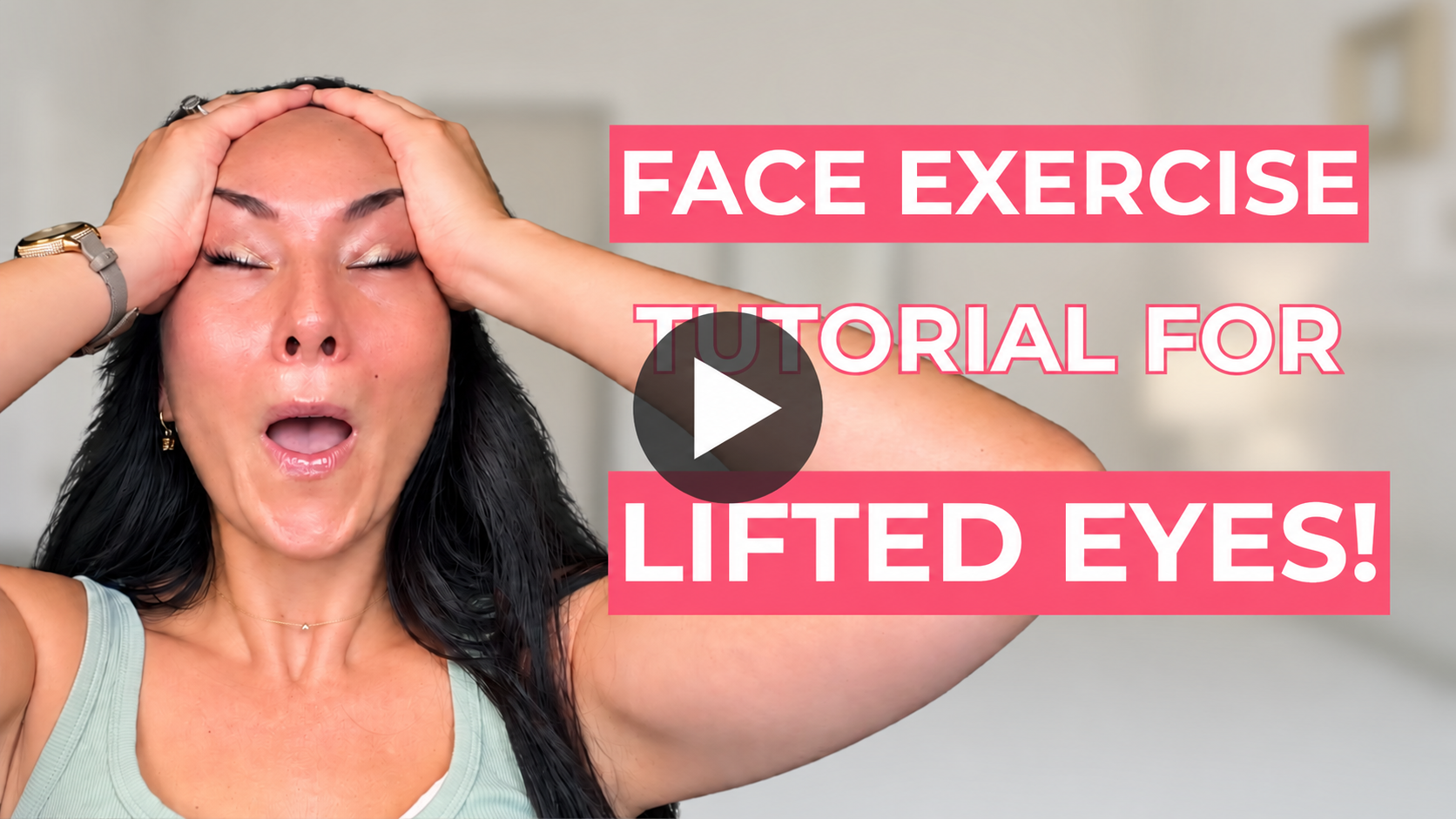
Before you begin, notice how your eyes feel. Is one side heavier? Are you holding tension between your eyebrows?
Afterward, check in again without looking for perfection. Notice any difference in comfort or sensation, and remember that a temporary change is not proof of a lasting lift.
How often should you practice?
The video gives you one guided session; it does not prescribe a weekly schedule.
Start with a comfortable session and notice how you feel during and afterward. Shorter holds and fewer repetitions are fine while you learn the positions. Let comfort and control guide you rather than trying to do more.
There is no established practice frequency for correcting hooded eyelids with these exercises. If you experience pain, irritation, or persistent discomfort, stop and get advice before continuing.
Frequently asked questions
Can face yoga remove hooded eyelid skin?
Face yoga has not been shown to remove excess eyelid skin. Exercises work with movement; loose skin, brow position, and eyelid position are separate considerations.
Are hooded eyes and droopy eyelids the same?
No. Hooding usually refers to skin covering part of the upper eyelid. Ptosis refers to the eyelid edge itself sitting too low. They can occur together, which is one reason an eye assessment can be useful.
Can I start face yoga later in life?
You can explore a gentle facial movement practice later in life if it is comfortable and suitable for you. Your age alone does not tell us what changes to expect. Begin with the positions you can control without straining.
Should I do these exercises every day?
This tutorial does not give a daily prescription. Learn the technique first, use comfortable holds, and pay attention to how your eyes, jaw, and neck feel. Daily practice is not a guarantee of better results.
What if one eye looks more hooded than the other?
Notice whether the difference is longstanding or new. Don’t compensate by pulling harder or adding repetitions on one side. A new or increasing difference, especially with a drooping eyelid or vision changes, should be assessed.
A complete practice for your face
If you’ve been collecting separate videos for your eyes, forehead, jaw, and neck, you may be wondering how to put everything together.
That’s why I created Le Glow Studio.
Inside the app, you can follow guided routines organized by facial area, use the weekly schedules, and explore a fuller practice that includes facial massage, tension release, and facial exercises.
Instead of deciding which technique to try next every day, you have guidance to help face care fit into your life.
Discover the Le Glow Studio app →
A few minutes to care for your face can also be a moment to breathe, slow down, and pay attention to yourself. That matters too.
